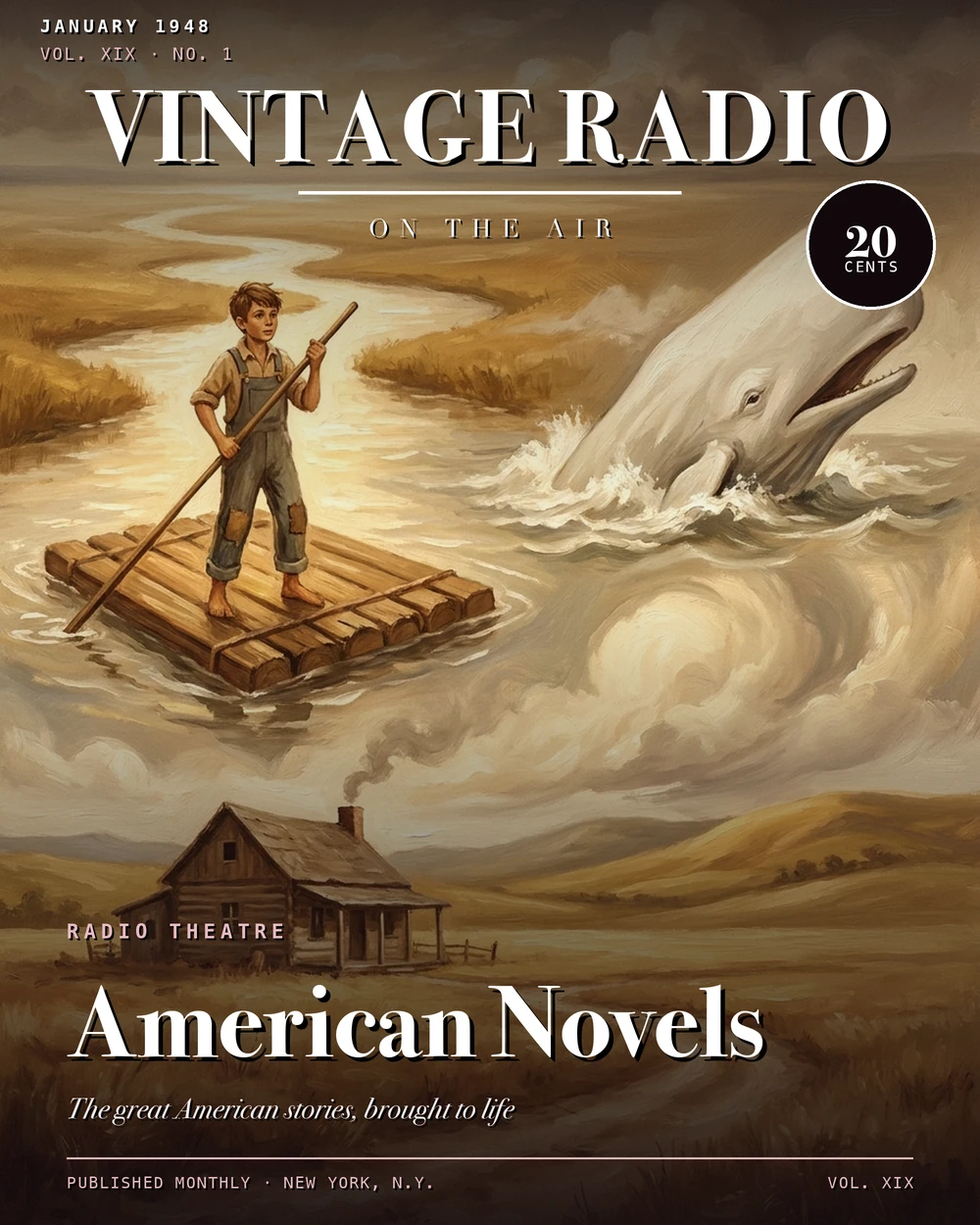
American Novels
A Summer Classroom on the Radio
American Novels launched on the Fourth of July, 1947 — a fitting premiere date for a series dedicated entirely to works by American authors. The show aired Friday nights on NBC, originating from Chicago's WMAQ, and ran during the summers of 1947 and 1948 as a replacement for the parent series, The World's Great Novels, while that program was on its seasonal hiatus. Each episode ran thirty minutes, presenting abridged and serialized dramatizations of titles most listeners already knew by name, even if they hadn't read them in years.
The distinction that set American Novels apart from The World's Great Novels was a deliberate one: where the parent series ranged across international literature, this summer edition focused specifically on American writers. The premiere episode adapted Herman Melville's Moby-Dick. Mark Twain's Tom Sawyer followed in a two-part broadcast beginning July 18, 1947. Other documented titles included Louisa May Alcott's Little Women and Washington Irving's The Legend of Sleepy Hollow — a range that moved between adventure, domestic fiction, and gothic Americana.
The Woman Who Built It
The series existed because of Margaret Cuthbert, who produced both The World's Great Novels and, by extension, American Novels in her role as NBC's Director of Women's Programs. Cuthbert had been at NBC since 1926, when the network absorbed AT&T's WEAF and brought her on as Director of Talks. By the mid-1940s she was overseeing the Chicago literary programming that gave American Novels its production base, its on-air roster, and its educational framework.
That framework was the NBC University of the Air, which partnered with institutions including the University of Louisville, the University of Tulsa, Kansas State Teachers College, and Washington State College to offer accredited correspondence courses tied to the broadcasts. Listeners could follow along with a study guide — the Handbook of the World's Great Novels, available for twenty-five cents — and, if enrolled through a partner institution, earn college credit. American Novels was considered more of a summer survey than a full academic-year offering, and colleges adopted it less widely for summer curricula than they had the parent series during the regular season.
In 1948, Cuthbert retooled the entire Chicago literary enterprise into NBC University Theater, which relocated to Hollywood, expanded to one-hour episodes, and won a Peabody Award that same year. American Novels had been one of the building blocks of that evolution.
The Chicago Company
The production drew from a Chicago cast pool that appeared across both the parent and summer series. Regulars included Harry Elders, Harriet Allyn, Boris Aplon, Cliff Norton, Johnny Coons, Cliff Soubier, Jess Pugh, Charles Flynn, and Sherman Marks. The broader company shared by these Chicago NBC literary programs also included Ken Nordine, who narrated some episodes, and Hope Summers, among others.
Music came from two Chicago-based figures: Emil Soderstrom, born Emil Otto Edvard Söderström in 1901, and Bernard "Whitey" Berquist, born Bernard H. Berquist in 1903. Homer Heck directed. The announcing duties on the wider Chicago literary series rotated among Charles Chan, John Conrad, and Dave Garroway — the same Dave Garroway who was then stationed at WMAQ and would go on to become the founding host of NBC's Today program in 1952.
What Came After
The final broadcast of the Chicago literary series — the run that American Novels had twice supported as a summer stand-in — aired July 23, 1948, with readings from Thomas Wolfe. By that point the operation was already shifting west. NBC University Theater debuted July 30, 1948, from Hollywood, running until February 14, 1951. It expanded the format beyond novels to include short stories and plays, and occasionally featured commentary from writers and critics. At one point the producers even dropped the word "University" from the title in an effort to shake the perception that the programming was too academic for general audiences.
American Novels itself was a brief and functional piece of that larger story — two summers of Friday-night dramatizations that kept the Chicago literary tradition on the air and helped lay the groundwork for what would become one of the more formally recognized drama series of the late 1940s. Fourteen episodes are documented as surviving, representing just under seven hours of audio across the two seasons the show ran.